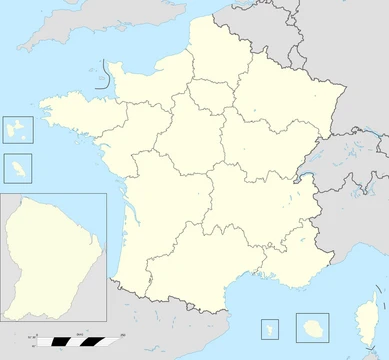
Pays de la Loire
Administrative region on France's Atlantic coast, centered on Nantes.
Pays de la Loire is one of France's eighteen administrative regions, situated on the Atlantic coast. It was established in the 1950s as a zone of influence for its capital and largest city, Nantes, which is one of the country's designated "balancing metropolises" (métropoles d'équilibre). The region's population stood at 3,832,120 in 2020.
Located in western France, the region is bordered by Brittany to the northwest, Normandy to the north, Centre-Val de Loire to the east, Nouvelle-Aquitaine to the south, and the Bay of Biscay of the North Atlantic Ocean to the southwest.
Pays de la Loire is divided into five departments: Loire-Atlantique, Maine-et-Loire, Mayenne, Sarthe, and Vendée. Its territory draws from several historical provinces. Loire-Atlantique contains part of Brittany, including its former capital Nantes, representing about 20% of historical Brittany (the remaining 80% forms the neighboring region of Brittany). Anjou is largely within Maine-et-Loire, with the rest in adjoining departments; the entire historical province lies inside Pays de la Loire. Maine is split between Mayenne and Sarthe, wholly contained in the region. Vendée holds part of Poitou, though most of that province is in Nouvelle-Aquitaine. The northeast of Sarthe includes part of Perche, with the rest in Normandy and Centre-Val de Loire. A small part of Touraine lies in the southeast of Maine-et-Loire, while most of Touraine is in the Centre region. The region's name, chosen by the central government, is a postwar geographical reference—"Lands of the Loire"—rather than a historical one.
The Loire Valley, a UNESCO World Heritage Site since 2000, spans both Pays de la Loire and Centre-Val de Loire. Most of the valley's châteaux in Pays de la Loire—such as Montsoreau, Angers, Saumur, and Brézé—are in Maine-et-Loire. The region also features notable monuments like the castles of Laval, the Nantes Château des Ducs de Bretagne, the Royal Fontevraud Abbey (the largest monastic complex in Europe), and the old city of Le Mans. Natural parks include the Brière and the Marsh of Poitou.
Population growth has been steep, driven by migration from across France as Nantes rose in prominence.
In 2018, the region's gross domestic product was €119.1 billion, accounting for 5.1% of French economic output. GDP per capita adjusted for purchasing power was €28,200, or 94% of the EU27 average that y
- Region type
- Administrative region of France
- Capital
- Nantes
- Population (2020)
- 3,832,120
- Departments
- Loire-Atlantique, Maine-et-Loire, Mayenne, Sarthe, Vendée
- GDP (2018)
- €119.1 billion
- GDP per capita (2018)
- €28,200 (94% of EU27 average)
- Main airport
- Nantes Atlantique Airport
Lore & Background
Pays de la Loire was created in the 1950s as a postwar administrative region, its name chosen by the French central government as a purely geographical reference—'Lands of the Loire'—rather than based on historical provinces. It comprises five departments: Loire-Atlantique, Maine-et-Loire, Mayenne, Sarthe, and Vendée. The region incorporates parts of several historical provinces: about 20% of Brittany (including its old capital Nantes), all of Anjou, all of Maine, part of Poitou, part of Perche, and a small part of Touraine.
The region's population saw a steep increase, particularly as people migrated from all over France to the Loire region due to the rise of Nantes to prominence. The Loire Valley, a UNESCO World Heritage Site since 2000, lies partly within Pays de la Loire, and the region contains numerous prominent monuments, including the castles of Laval, the Nantes Château des Ducs de Bretagne, the Royal Fontevraud Abbey (the widest monastic ensemble in Europe), and the old city of Le Mans. It also has many natural parks such as the Brière and the Marsh of Poitou.
Reader's Guide
Pays de la Loire is significant as a French administrative region created in the 1950s to serve as a zone of influence for Nantes, a balancing metropolis. Its economy is substantial, with a GDP of €119.1 billion in 2018, accounting for 5.1% of French economic output, and GDP per capita adjusted for purchasing power at 94% of the EU27 average. The region's legacy includes its role in concentrating population and economic activity around Nantes, and its preservation of cultural heritage from multiple historical provinces, including Brittany, Anjou, Maine, Poitou, Perche, and Touraine. The region's major communities include Nantes (the sixth most populated city in France), Angers, Le Mans, Saint-Nazaire, and others. Its transport hub is Nantes Atlantique Airport. The region's name, chosen by the central government, reflects a postwar administrative logic rather than historical continuity, making it a notable example of modern regional planning in France.
Did You Know?
- Pays de la Loire was created in the 1950s as a zone of influence for Nantes, one of a handful of French 'balancing metropolises'.
- The region's name was chosen by the French central government as a purely geographical reference, not based on history.
- Pays de la Loire comprises parts of six historical provinces: Brittany, Anjou, Maine, Poitou, Perche, and Touraine.
- The Royal Fontevraud Abbey, located in the region, is the widest monastic ensemble in Europe.
More in French Regions 1-21
Spotted an error? Know more?
This is a living reference — every entry is fact-audited, and reader corrections feed straight into our audit queue. Suggest an edit · See this site's audit record