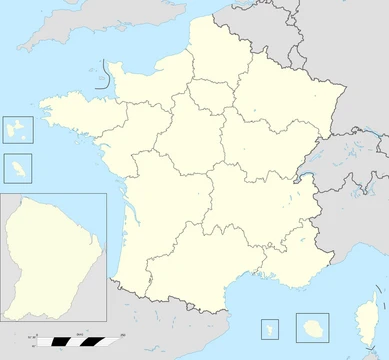
Midi-Pyrénées
Former French region, largest in area, centered on Toulouse.

Wikipedia / Wikimedia Commons
Midi-Pyrénées was a former administrative region of France, created in the late 20th century as a hinterland and zone of influence for its capital, Toulouse. It was the largest region of Metropolitan France by area, larger than the Netherlands or Denmark, and has no historical or geographical unity. Since 1 January 2016, it has been part of the new region of Occitania.
- type
- Former administrative region of France
- capital
- Toulouse
- area
- Largest region of Metropolitan France by area
- existed
- Late 20th century until 31 December 2015
- succeeded_by
- Occitania (since 1 January 2016)
- languages
- French (dominant), Occitan (Languedocian and Gascon dialects)
- flag
- Occitan cross (derived from coat of arms of the old county of Toulouse)
Lore & Background
Midi-Pyrénées was composed of several former French provinces: Gascony (24.2% of its territory), Languedoc (23.4%), Rouergue (19.9%), Quercy (15.4%), a collection of small Pyrenean provinces (16.6%), and Agenais (0.5%). The Pyrenean provinces—Couserans, Nébouzan, Quatre-Vallées, and Bigorre—are sometimes considered part of Gascony, a matter of debate due to their distinct identities and separate provincial states until the French Revolution. The region was created as one of a handful of 'balancing metropolises' (métropoles d'équilibre), similar to Rhône-Alpes for Lyon.
In the Middle Ages, most of the area was ruled by the Count of Toulouse, and after the French conquest, the Parlement of Toulouse extended its jurisdiction over all the territories that became Midi-Pyrénées. The region's population is sharply divided: the metropolitan area of Toulouse is densely populated (up to 3,500 inhabitants per km²), while the rest is sparsely populated (12 to 60 inhabitants per km²). The traditional dialects of Occitan—Languedocian in the east and northeast, Gascon in the west and southwest—were spoken until the early 20th century, but today French is dominant, with Occitan mainly spoken by older people in remote areas.
Reader's Guide
Midi-Pyrénées is significant as a late-20th-century administrative creation designed to balance the influence of Paris by making Toulouse a regional capital. Its lack of historical or geographical unity reflects its artificial composition from multiple historic provinces, each with distinct identities. The region's demographic and linguistic contrasts—between the booming, educated Toulouse and the aging, depopulating countryside, and between Languedocian and Gascon Occitan—highlight the challenges of regional integration. The adoption of the Occitan cross as its flag, despite the majority of inhabitants living in the Languedoc part, underscores the cultural weight of Toulouse. The region's legacy continues in Occitania, but its internal divisions and the decline of Occitan usage illustrate broader trends in French regionalism and language shift. The debate over whether the Pyrenean provinces belong to Gascony or are separate entities remains unresolved, reflecting the complexity of historical boundaries.
Did You Know?
- Midi-Pyrénées was larger than the Netherlands or Denmark.
- The region had no historical or geographical unity; it was created as a hinterland for Toulouse.
- The Occitan cross, derived from the coat of arms of the old county of Toulouse, was adopted as the region's official flag.
- Gascon and Languedocian Occitan were traditionally spoken in different parts of the region, with Toulouse lying near the limit between the two.
Frequently Asked Questions
Who is Midi-Pyrénées?
Midi-Pyrénées was a former administrative region of France, established in the late 20th century with Toulouse as its capital. It functioned essentially as a hinterland and zone of influence surrounding that city, rather than as a naturally unified territory.
What are Midi-Pyrénées's powers or role?
Its defining trait was sheer size: it was the largest region in Metropolitan France by area, bigger than the Netherlands or Denmark. Despite that scale, it possessed no genuine historical or geographical cohesion among its constituent departments.
How does Midi-Pyrénées's story end?
The region's existence concluded on 31 December 2015, when it was dissolved as part of a national administrative reorganization. From 1 January 2016 onward, its territory was folded into the newly created region of Occitania.
Why is Midi-Pyrénées important to fans of French regions?
It holds the record as the largest former region in Metropolitan France, making it a notable case study in how artificial administrative boundaries can span vastly different landscapes. Its dissolution also illustrates the broader wave of French regional mergers in the 2010s.
What languages are associated with Midi-Pyrénées?
French was the dominant language across the region, while Occitan—specifically its Languedocian and Gascon dialects—was also spoken in various parts of the territory.
More in French Regions 1-21
Spotted an error? Know more?
This is a living reference — every entry is fact-audited, and reader corrections feed straight into our audit queue. Suggest an edit · See this site's audit record