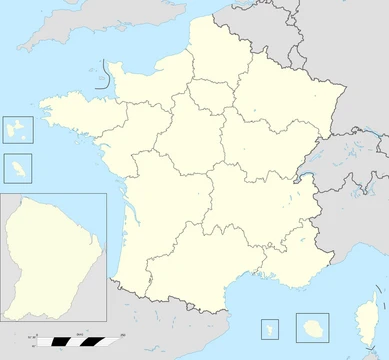
Alsace
A border region blending German and French cultures, historically contested.

Wikipedia / Wikimedia Commons
Alsace is a cultural region and territorial collectivity in northeastern France, on the west bank of the upper Rhine, bordering Germany and Switzerland. Its culture blends German and French influences, and its largest city, Strasbourg, serves as the seat of several international organizations. Historically, Alsace has shifted between French and German control, being part of the Holy Roman Empire, annexed by France in the 17th century, and later incorporated into the German Empire in 1871 before returning to France after World War I.
- Population (January 2021)
- 1,919,745
- Largest City
- Strasbourg
- Administrative Status
- European Collectivity of Alsace (since 2021), part of Grand Est region
- Historical Periods
- Holy Roman Empire, French annexation (17th century), German Empire (1871–1919), French Third Republic (1919–1940), German occupation (1940–1944), French control (after 1944)
- Languages
- Alsatian (Alemannic dialect), French (primary since WWII)
- Notable Federation
- Décapole (federation of ten free towns)
Lore & Background
Alsace was inhabited by nomadic hunters in prehistoric times and later became part of the Roman province of Germania Superior. After the decline of Rome, it was settled by the Alemanni, whose language formed the basis of modern Alsatian. Under the Franks, it became part of the Kingdom of Austrasia and was Christianized. Following the Treaty of Verdun in 843, Alsace became part of Middle Francia, then Lotharingia, and eventually the stem duchy of Swabia within the Holy Roman Empire. During the 12th and 13th centuries, it prospered under Hohenstaufen emperors, with Strasbourg gaining status as a free imperial city in 1262 and becoming a major trade hub.
Reader's Guide
Alsace's significance lies in its long history as a contested borderland between France and Germany, shaping its unique cultural and linguistic identity. The region was part of the Holy Roman Empire until French annexation in the 17th century, then became German again in 1871 after the Franco-Prussian War. Returned to France in 1919, it was reoccupied by Germany during World War II and restored to France in 1944. This back-and-forth has left Alsace with a blend of German and French influences, evident in its architecture, cuisine, and the Alsatian dialect. Economically, Strasbourg serves as a major European hub, hosting international organizations. The region's administrative status has evolved, most recently merging into the European Collectivity of Alsace in 2021 while remaining part of the Grand Est region, though a 2026 bill proposes separation.
Did You Know?
- The name Alsace likely comes from Old High German 'Ali-saz' or 'Elisaz', meaning 'foreign domain'.
- In 1349, Jews in Alsace were accused of poisoning wells during the Black Death, leading to the Strasbourg pogrom.
- Alsace was part of the Décapole, a federation of ten free towns within the Holy Roman Empire.
- The 1356 Rhine rift earthquake, one of Europe's worst, devastated Basel and affected Alsace.
Frequently Asked Questions
What is Alsace and where is it located?
Alsace is a northeastern French region sitting on the west bank of the upper Rhine, directly bordering both Germany and Switzerland. It is best known for a distinctive cultural identity that weaves together French and German traditions into something genuinely its own.
What are Alsace's unique traits or 'powers'?
The region speaks its own Alemannic dialect alongside French and carries a heritage shaped by centuries of dual cultural influence. It also once hosted the Décapole, a remarkable federation of ten semi-independent free towns that governed themselves for generations.
How does Alsace's story play out historically?
The region has repeatedly flipped between French and German sovereignty, moving from the Holy Roman Empire to French control in the 1600s, then into the German Empire from 1871 to 1919, and back to France after the First World War. That pendulum swung once more during the 1940s occupation before settling permanently under French rule after 1944.
Why is Alsace important on a broader level?
Strasbourg, its largest city, serves as the home base for several major international organizations, giving the region a diplomatic weight far beyond its modest size. Its contested past also makes it a living symbol of Franco-German reconciliation in modern Europe.
What is Alsace's current administrative status?
Since 2021 it operates as the European Collectivity of Alsace, a territorial collectivity nested within the larger Grand Est region. Its population was recorded at roughly 1.9 million in early 2021.
More in French Regions 1-21
Spotted an error? Know more?
This is a living reference — every entry is fact-audited, and reader corrections feed straight into our audit queue. Suggest an edit · See this site's audit record