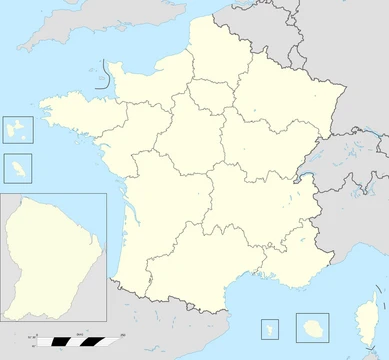
Champagne-Ardenne
Former French region known for Champagne wine and agriculture.
Champagne-Ardenne was an administrative region in northeastern France that no longer exists. It shared a border with Belgium and largely matched the historic province of Champagne, famous for its namesake sparkling white wine. Created in 1956, the region included four departments: Aube, Ardennes, Haute-Marne, and Marne. It ceased to be an independent entity on January 1, 2016, when it combined with Alsace and Lorraine to become the new region of Grand Est.
The region’s rivers mostly flow westward, including the Seine, the Marne, and the Aisne, while the Meuse flows north. Major highways included the A4, linking Paris and Strasbourg and serving the Reims area; the A5, connecting Paris and Dijon and serving Troyes and Chaumont; the A26, running from Calais to Troyes and passing through Reims and Châlons-en-Champagne; and the A34, connecting Reims to the Belgian border and serving Charleville-Mézières. The rail network featured the Paris–Strasbourg line along the Marne Valley, serving Épernay, Châlons-en-Champagne, and Vitry-le-François, as well as the LGV Est TGV line, which opened in 2007 and serves Reims via a station in Bezannes. Canals included the Canal latéral à la Marne and the Marne-Rhine Canal, which connects to the Marne at Vitry-le-François; both are petit gabarit canals. Vatry International Airport, mainly used for air freight, has a 3,650-meter runway and sits in a sparsely populated area about 150 kilometers from Paris.
Agriculture covered 61.4% of the land. The region ranked first in France for barley and alfalfa production, second for beets, onions, and peas, and third for tender wheat and rapeseed. It had 282.37 square kilometers of vineyards. In 2001, Champagne sales reached 263 million bottles, a 4% increase from 2000, with 37.6% exported. The region also accounted for 25% of French hosiery production and was the third-largest metallurgic region in France. Notable businesses included Verreries Mécaniques de Champagne, Produits Métallurgiques à Reims, and Vallou. Food processing companies included Champagne-Céréales, France-Luzerne, and Béghin-Say.
The population of Champagne-Ardenne had been steadily declining since 1982 due to rural exodus. With about 1.3 million people and a density of 52 per square kilometer, it was one of France’s least populated regions. After stabilizing briefly in the 1990s, its population became among the fastest
- born
- 1956 (as administrative region)
- died
- 1 January 2016 (merged into Grand Est)
- field
- Administrative region, wine production, agriculture, metallurgy
- nationality
- French
- known_for
- Champagne sparkling wine, agricultural production, declining population
Lore & Background
Champagne-Ardenne was formed in 1956 as an administrative region comprising the departments Aube, Ardennes, Haute-Marne, and Marne. Its geography included rivers flowing west—the Seine, Marne, and Aisne—and the Meuse flowing north. The region's transportation network featured highways A4, A5, A26, and A34, as well as the Paris–Strasbourg rail line and the LGV Est TGV line, which opened in 2007 and served Reims via a station in Bezannes. Canals included the Canal latéral à la Marne and the Marne-Rhine Canal, both petit gabarit. Vatry International Airport, primarily for air freight, had a 3,650-meter runway and was located 150 km from Paris.
Reader's Guide
Champagne-Ardenne held significance as a major agricultural and industrial region. 61.4% of its land was dedicated to agriculture, and it ranked first in France for barley and alfalfa production, second for beets, onions, and peas, and third for tender wheat and rapeseed. It contained 282.37 km² of vineyards, and in 2001 Champagne sales reached 263 million bottles, with 37.6% exported. The region was also the third metallurgic region in France and produced 25% of French hosiery. Its population, however, had been in steady decline since 1982 due to rural exodus, making it one of France's least populated regions and among the fastest 'dying' in Europe, with a weak fertility rate and minimal immigrant population. Major communities included Châlons-en-Champagne, Charleville-Mézières, Chaumont, Épernay, Reims, Saint-Dizier, Sedan, and Troyes.
Did You Know?
- Champagne-Ardenne was formed in 1956 and merged into Grand Est on 1 January 2016.
- The region ranked first in France for production of barley and alfalfa.
- Champagne sales in 2001 totaled 263 million bottles, with 37.6% exported.
- The region's population has been in steady decrease since 1982 due to rural exodus.
Frequently Asked Questions
Who is Champagne-Ardenne?
Champagne-Ardenne was a northeastern French administrative region that occupied territory largely matching the old province of Champagne and shared a border with Belgium. It was made up of four departments: Aube, Ardennes, Haute-Marne, and Marne.
What are Champagne-Ardenne's powers or role?
The region is most celebrated for producing the sparkling white wine that carries its name, while also sustaining a strong agricultural and metallurgical economy. Its rivers—the Seine, Marne, Aisne, and Meuse—served as long-standing trade and transport corridors.
How does Champagne-Ardenne's story end?
On 1 January 2016, the region lost its independent status when it was merged with Alsace and Lorraine to form the new region of Grand Est. This brought to a close roughly sixty years of separate administrative identity, having been established in 1956.
Why is Champagne-Ardenne important?
Its globally recognized champagne industry gave it cultural and economic weight far beyond its modest size, and its position along major waterways and highways made it a key logistical node in northeastern France. The region also contributed significantly to national food production and metalworking.
Who are Champagne-Ardenne's four constituent parts?
The region was divided into the departments of Aube, Ardennes, Haute-Marne, and Marne. Each brought its own character, from the vineyard valleys of the Marne to the dense, hilly forests of the Ardennes.
More in French Regions 1-21
Spotted an error? Know more?
This is a living reference — every entry is fact-audited, and reader corrections feed straight into our audit queue. Suggest an edit · See this site's audit record