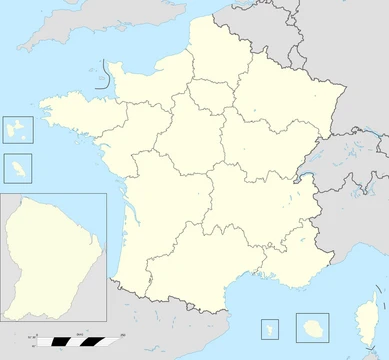
Normandy
Historical region and former duchy in northwestern Europe.
Normandy is a region in northwestern Europe, both geographical and cultural, that largely matches the borders of the historic Duchy of Normandy. It includes mainland Normandy, which is part of France, and insular Normandy, made up mostly of the British Channel Islands. The area covers 30,627 square kilometers, and in 2017 its population was 3,499,280. People from Normandy are called Normans, and the region is the original home of the Norman language. Major settlements include Rouen, Caen, Le Havre, and Cherbourg.
The cultural region closely follows the old Duchy of Normandy, which also covers small parts of what are now the departments of Mayenne and Sarthe. The Channel Islands, known in French as Îles Anglo-Normandes, are historically part of Normandy as well. They cover 194 square kilometers and consist of two bailiwicks, Guernsey and Jersey, which are British Crown Dependencies. The name Normandy comes from the settlement of the area by Vikings, or "Northmen," starting in the 9th century, and was confirmed by a treaty in the 10th century between King Charles III of France and the Viking jarl Rollo. For nearly 150 years after the Norman conquest of England in 1066, the same person ruled as both Duke of Normandy and King of England, linking the two territories.
People have lived in Normandy since prehistoric times, as shown by cave art, megalithic monuments, and extensive Bronze Age settlements. In antiquity, the region was part of Celtic Armorica and was home to several Gallic tribes before the Romans conquered it by 51 BC. Under Roman rule, it became part of the province of Lugdunensis Secunda, whose borders later influenced Normandy’s development, and it was also included in the Saxon Shore. After Roman authority collapsed, the area came under Frankish control and was integrated into the kingdoms of Neustria and later the Carolingian Empire. Normandy gets its name from Norse settlers, the Northmen, who settled in the lower Seine valley during the 9th and early 10th centuries. In 911, the Viking leader Rollo made an agreement with King Charles the Simple in the Treaty of Saint-Clair-sur-Epte, gaining control of territory around Rouen in exchange for military service and conversion to Christianity. Over the next century, the Norman rulers expanded their land, and the Scandinavian settlers gradually mixed with the local Frankish population, creating a dis
- area
- 30,627 square kilometres (11,825 sq mi)
- population_2017
- 3,499,280
- highest_point
- Signal d'Écouves (417 m)
- forest_cover
- 12.8%
- major_settlements
- Rouen, Caen, Le Havre, Cherbourg
Lore & Background
Normandy has been inhabited since prehistoric times, with archaeological evidence including cave art, megalithic monuments and extensive Bronze Age settlements. During antiquity the region formed part of Celtic Armorica and was occupied by several Gallic peoples before being conquered by the Romans by 51 BC. Under Roman rule it became part of Lugdunensis Secunda, a province whose boundaries would later influence the development of Normandy and was incorporated into the Saxon Shore. Following the collapse of Roman authority, the region passed under Frankish control and became integrated into the kingdoms of Neustria and later the Carolingian Empire.
Normandy takes its name from the Norse settlers known as Northmen who established themselves in the lower Seine valley during the 9th and early 10th centuries. In 911, the Viking leader Rollo reached an agreement with King Charles the Simple in the Treaty of Saint-Clair-sur-Epte, recognising his possession of territory around Rouen in return for military service and conversion to Christianity. Over the following century the Norman rulers expanded their territory, while the Scandinavian settlers gradually assimilated with the local Frankish population to create a distinct Norman identity and the Duchy of Normandy with a highly advanced French culture epitomised by the Norman monastic revival.
The duchy became one of the most influential states in medieval Europe. In 1066, Duke William the Conqueror won the Battle of Hastings and became King of England, creating enduring political, cultural and linguistic links across the English Channel. Norman adventurers and rulers also played major roles in the Norman conquest of southern Italy, the establishment of the Kingdom of Sicily, the Crusades and wider European expansion.
Reader's Guide
Normandy's significance stems from its role as a medieval duchy that shaped European history through the Norman conquest of England in 1066 and subsequent influence in southern Italy, Sicily, and the Crusades. The region's name originates from Viking settlement in the 9th and 10th centuries, formalized by the Treaty of Saint-Clair-sur-Epte in 911. Mainland Normandy was incorporated into the French royal domain in 1204, though the Channel Islands remained linked to the English Crown. The region contributed to French maritime exploration and colonization, producing figures such as Samuel de Champlain. During the Second World War, Normandy became the site of the Normandy landings on 6 June 1944 and the subsequent Battle of Normandy, a decisive campaign that contributed to the liberation of France and Western Europe from Nazi Germany. Today, mainland Normandy is a French administrative region created in 2014 by merging Lower and Upper Normandy, while the Channel Islands remain British Crown Dependencies that continue to recognize the British monarch as Duke of Normandy in a traditional and ceremonial sense.
Did You Know?
- The highest point in Normandy is the Signal d'Écouves, at 417 metres.
- Normandy's name comes from Viking settlers known as 'Northmen' who arrived in the 9th century.
- The Channel Islands are British Crown Dependencies but are historically part of Normandy.
- The region is sparsely forested, with only 12.8% wooded compared to the French average of 23.6%.
More in French Regions 1-21
Spotted an error? Know more?
This is a living reference — every entry is fact-audited, and reader corrections feed straight into our audit queue. Suggest an edit · See this site's audit record